I Why Brand Reputation Is Your New Startup Currency
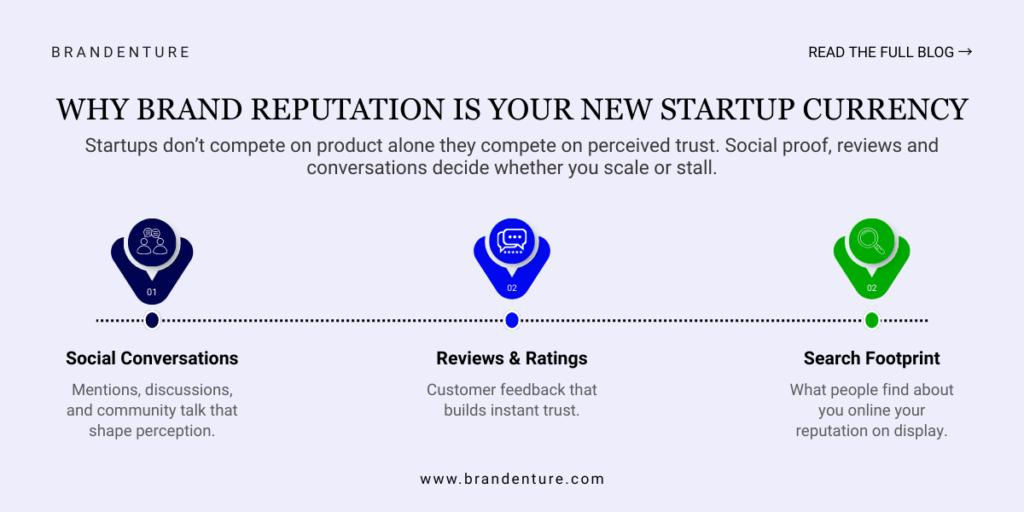
The world is operating digital-first. This means today, startups don’t compete on products alone, they compete on perceived trust. Your social media presence, customer experience, reviews, and online conversations shape your business reputation long before a buyer ever visits your website.
And for solopreneurs, small businesses, and early-stage startups, brand reputation can be the difference between explosive growth… and complete invisibility.
Because your audience doesn’t want to guess whether you’re trustworthy, they want proof. Proof that you deliver. Evidence that you care. Proof that others trust you.
That proof shows up in:
- Your social media conversations
- Your reviews
- Your transparency
- Your customer stories
- Your online footprint
This is where reputation management becomes a foundational business strategy not a “PR fix” or a “crisis response tool.”
Brandenture has worked with ambitious founders who learned early that your business reputation either works for you… or against you. Startups that commit to brand reputation management from Day 1 scale faster, convert better, and attract better-quality customers.
This playbook gives you the complete, actionable, startup-focused framework for building a strong brand reputation using social media, customer experience, and proactive communication.
II. Understanding Modern Reputation Management (RM 2.0)
A. What Reputation Management Really Means Today
Twenty years ago, reputation management was mostly about press releases and crisis statements.
Today, it’s the backbone of growth.
Modern reputation management = building, monitoring, and amplifying trust across every digital touchpoint.
It includes:
- Social media sentiment
- Customer reviews
- Influencer mentions
- Audience feedback
- Search engine results
- Brand storytelling
- Founder visibility
This is why reputation management marketing has taken over traditional PR.
It blends:
- Content
- Messaging
- Customer experience
- Social proof
- Social listening
- Organic + paid positioning
Startups that understand this shift win early because they build trust faster than their competitors.
B. The 5 Layers of Digital Reputation Every Startup Has
Every business, regardless of size or industry, has five unavoidable components of online reputation:
1. Brand Authority
How credible and expert you appear through your content, messaging, and presence.
2. Social Proof
Reviews, testimonials, comments, UGC, and customer results.
3. Social Media Perception
How your audience talks about you publicly.
4. Customer Sentiment
Positive, neutral, or negative emotional reactions to your brand.
5. Search Engine Reputation
What potential customers discover about you through Google.
Ignoring any one of these can weaken the rest.
C. Why Startups Fail at Reputation Management
Most solopreneurs and SMBs struggle because they rely on:
- Inconsistent posting
- Random content without strategy
- No monitoring of brand mentions
- Slow response times
- Zero review management
- No crisis plan
- One-platform dependency
- Lack of founder visibility
This playbook eliminates these weaknesses by giving you a complete reputation management system, not just tactics.
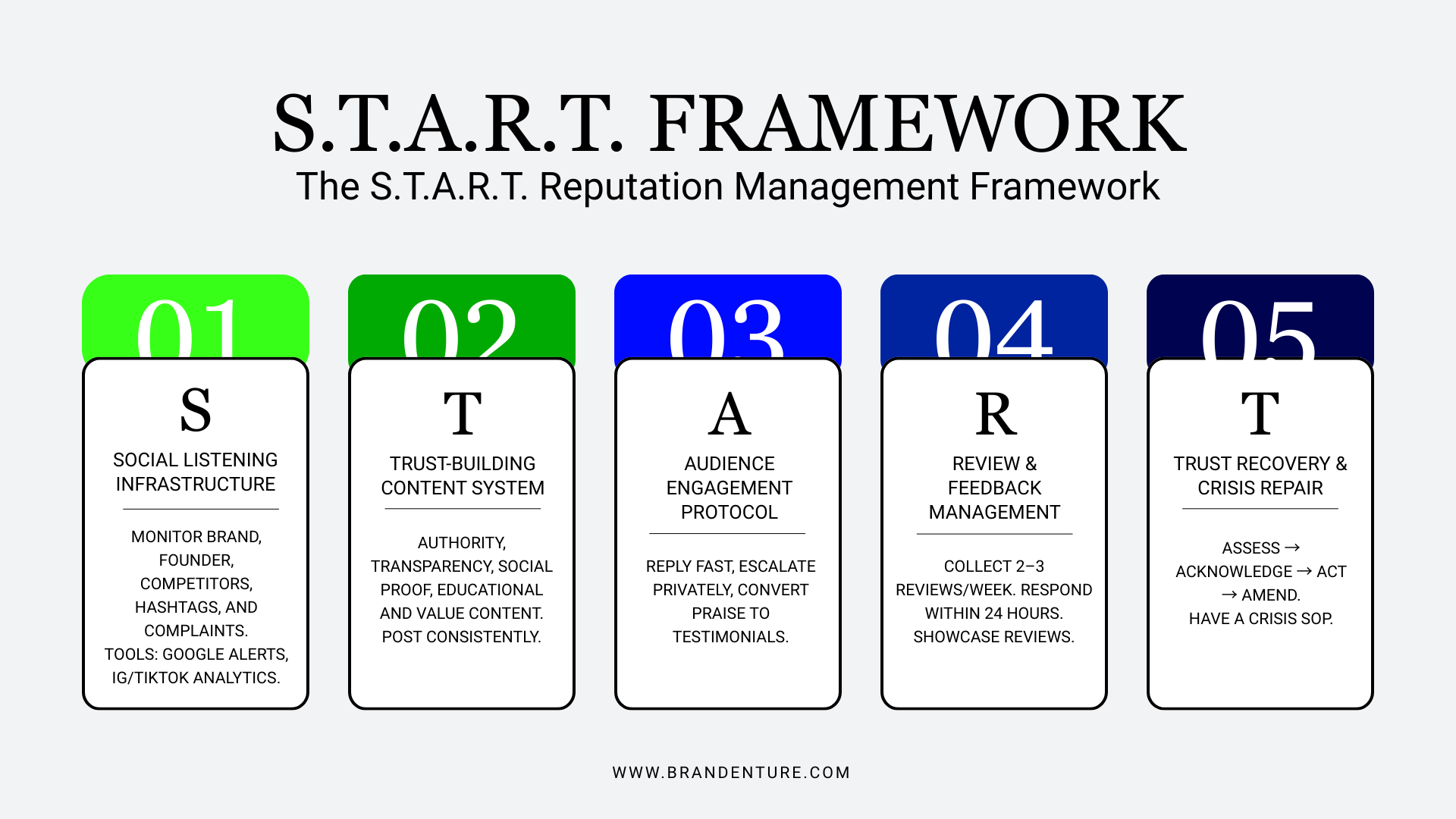
III. The S.T.A.R.T. Reputation Management Framework™
A proprietary Brandenture model designed for startups & SMBs.
This is the framework that will help you operationalize, automate, and scale your brand reputation with consistency.
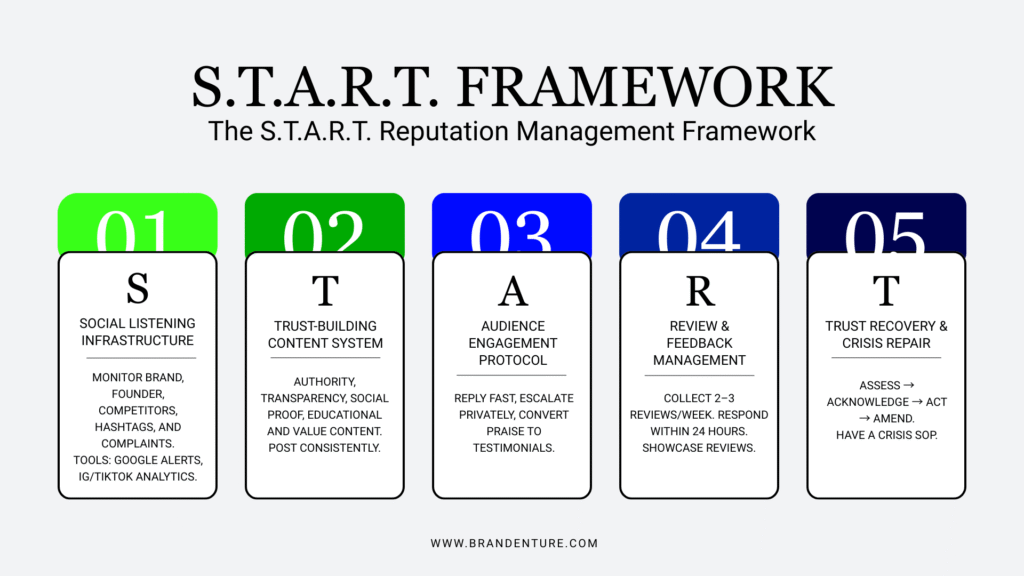
S – Social Listening Infrastructure
You can’t manage what you don’t monitor.
Social listening is the foundation of real rep management because it tells you:
- What people say about your brand
- Emerging customer frustrations
- Competitor weaknesses
- Content gaps
- New opportunities
- How your brand sentiment is shifting
Tools for startups & solopreneurs:
- Google Alerts
- Instagram & Facebook insights
- TikTok analytics
- YouTube analytics
Tools for SMBs:
- Brand24
- Mention
- Sprout Social
Enterprise tools (Reputation Pros / ORM suites):
- Meltwater
- Cision
- Brandwatch
- Reputation.com (Reputation Pros Online Reputation Management)
What to track:
- Brand name
- Founder name
- Competitor names
- Industry keywords
- Branded hashtags
- Product keywords
- Customer complaints
- Review site mentions
Why this matters:
You learn the truth about your reputation, not what you assume it is.
T – Trust-Building Content System
Trust is not built through random posting, it is built through strategic communication that positions your startup as credible, transparent, and customer-first.
Your content must prove:
- You know your industry
- You understand customer problems
- You have solutions
- You deliver results
- People trust you
- You share the truth behind your brand
Trust-Building Content Pillars:
- Authority Content: expert insights, frameworks, strategic tips
- Transparency Content: behind-the-scenes, founder story, real processes
- Social Proof Content: testimonials, screenshots, customer success
- Educational Content: how-tos, breakdowns, industry trends
- Value Content: problem-solving, actionable steps
- Community Content: customer shout-outs, UGC, collaborations
Frequency Strategy
- Solopreneurs: 4–5 posts/week
- SMBs: 3–4 posts/week + 2–3 stories/day
- Startups: 4–6 posts/week across 2 platforms
Format Mix
- Reels
- Carousels
- Stories
- LinkedIn posts
- TikTok videos
- Long-form YouTube
The more value you give, the more trust you earn, and the stronger your brand reputation management becomes.
A – Audience Engagement Protocol
Reputation isn’t built by posting; it’s built by conversation.
Your response speed, tone, and helpfulness directly influence your credibility.
Engagement Rules:
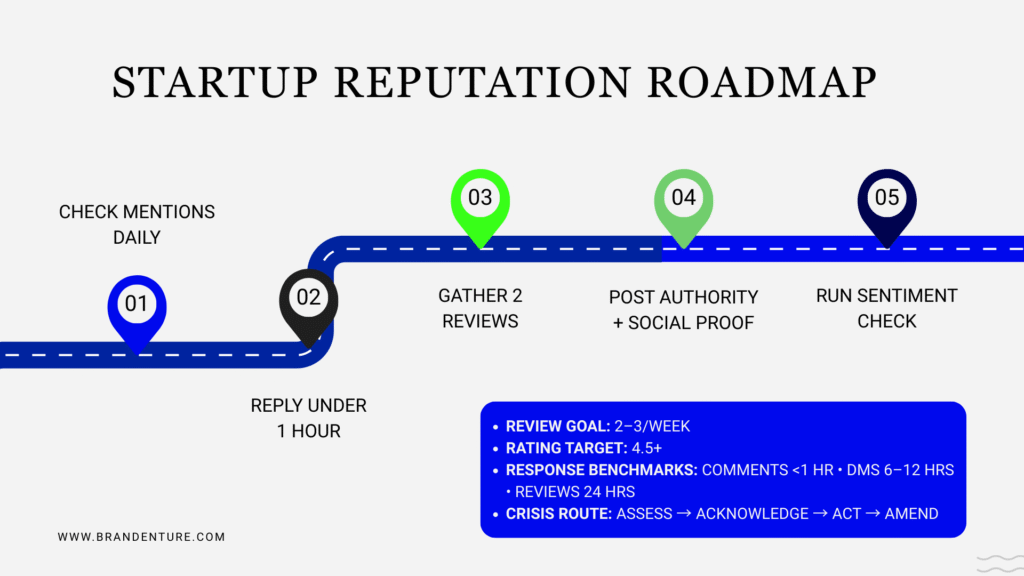
- Reply within 1 hour to comments (ideal)
- Respond to all DMs within 6–12 hours
- Have a pre-set response style (casual, friendly, authoritative)
- Never delete negative comments – address them professionally
- Escalate serious complaints privately
- Convert compliments into testimonials
Engagement SOP for Startups:
| Type of Comment | Response Time | Action |
| Praise | < 1 hour | Thank them, ask for review/testimonial |
| Inquiry | < 2 hours | Provide solution, link or reply |
| Complaint | < 30 minutes | Acknowledge publicly, resolve privately |
| Troll | Ignore or soft block | No engagement |
The more active your engagement, the more powerful your reputation management marketing becomes.
R – Review & Feedback Management
Reviews are the highest-impact reputation asset for any startup or SMB.
Your review platforms:
- Google Business Profile
- Facebook Reviews
- Instagram Replies
- LinkedIn Recommendations
- Trustpilot
- Industry-specific directories
Goals:
- Collect 2–3 reviews/week
- Maintain 4.5+ average rating
- Respond to every review within 24 hours
Strong Review Strategy:
- Ask for reviews after every delivery
- Use QR codes in-store
- Use automated email reminders
- Offer value (not rewards) for participation
- Showcase reviews on all social channels
Turning Negative Reviews Into Social Proof:
- Respond within 12 hours.
Acknowledge. - Apologize if necessary.
- Give solution.
- Ask them to update the review after the fix.
This is the mark of high-level rep management.
T – Trust Recovery & Crisis Repair
Every brand faces negative comments, PR issues, customer dissatisfaction, or viral misunderstandings at some point.
Startups with a crisis plan survive. Those without one, don’t.
Crisis Types:
- Customer complaint goes viral
- Misinformation spreads
- Competitor sabotage
- Employee behavior
- Product failure
- Founder controversy
The 4-Step Crisis Response Workflow:
1. Assess: What happened? What’s the impact?
2. Acknowledge: Respond publicly & immediately
3. Act: Provide solution, compensation, correction
4. Amend: Share what will change to prevent repeat
Big brands recover because they control the narrative early.
Small businesses must do the same.
IV. Building Your Social Media Reputation Engine
A strong brand reputation isn’t built on a website — it’s built where people see you every day: social media.
Platforms like Instagram, Facebook, TikTok, and LinkedIn have become the primary public stage where your audience evaluates:
- Your expertise
- Your values
- Your consistency
- How you treat customers
- How you respond to challenges
If your social media presence is weak, inconsistent, or disengaged, your brand reputation weakens instantly.
Let’s build your “Reputation Engine.”
A. The Role of Content in Reputation
Your content is your public character.
Everything you publish shapes perception:
- Are you credible?
- Are you consistent?
- Are you knowledgeable?
- Are you helpful?
- Are you present?
- Are you customer-centered?
High-reputation content formats:
- Expert breakdown videos
- Process transparency reels (“Here’s how we deliver results…”)
- Customer success stories
- Insightful carousels
- Founder thoughts (LinkedIn)
- UGC testimonials
This content positions you as a thought leader, not a random account posting for reach.
Trust is built through value, not volume.
B. Social Media Signals That Influence Reputation
Platforms use engagement and conversational signals to evaluate how people perceive your brand.
Key reputation signals include:
- Comments (especially meaningful ones)
- Saves
- Shares
- Positive mention frequency
- Tagging your brand
- User-generated content
- Public reviews
- Story replies
- Influencer mentions
- Average response time
When these signals are strong, your brand reputation grows naturally.
C. The Reputation-First Social Media Strategy
Instead of focusing on “posting more,” you focus on “posting strategically.”
Reputation KPIs:
- Sentiment score
- Positive mentions per week
- Negative mentions addressed per day
- Review volume
- Engagement quality (not quantity)
- Share-to-follow ratio
- Thought leadership visibility
Your Reputation-First Content Calendar
Each week should include:
| Content Type | Goal |
| Authority Post | Build expertise |
| Review/UGC Post | Boost credibility |
| Story Highlights | Reinforce trust |
| Problem-Solution Post | Show value |
| DM Replies | Build relationships |
| Founder Post | Humanize brand |
This is where reputation management marketing intersects with social media strategy.
V. Rep Management Tools & Tech Stack for Startups
Your reputation grows faster when supported by the right systems.
Here is the Startup → SMB → Scaleup tool progression recommended by Brandenture.
A. Solopreneur / Low-Budget Tools
Perfect for new startups:
- Google Alerts → Brand mentions
- Canva → Branded visuals
- Notion → RM processes
- Buffer / Meta Business Suite → Scheduling
- Instagram Insights → Audience behavior
B. SMB / Growing Business Tools
For teams managing multiple platforms:
- Brand24 → Reputation tracking
- Sprout Social → Social listening + engagement
- Hootsuite → Scheduling + monitoring
- Trustpilot → Review management
- Typeform → Feedback collection
C. Enterprise / Scaleup Tools (Reputation Pros ORM Suites)
For businesses needing full-scale reputation management:
- Brandwatch
- Meltwater
- Cision
- Reputation.com (Reputation Pros Online Reputation Management)
These offer:
- Advanced sentiment analysis
- Deep social listening
- Crisis detection
- Multi-channel monitoring
- Review system automation
The goal is to choose a tech stack that matches your growth stage.
VI. Reputation Management Marketing (Turning Trust Into Sales)
Reputation is not only about sentiment, it directly increases revenue.
A strong brand reputation:
- Lowers customer acquisition cost
- Increases conversion rate
- Reduces objections
- Strengthens customer loyalty
- Improves referral volume
- Boosts lifetime value
- Attracts investor interest
Here’s how to turn reputation into growth.
A. How Reputation Fuels Your Marketing Funnel
Reputation enhances every stage of your funnel:
Top of Funnel (TOFU)
Trust-building content makes people follow you before they need you.
Middle of Funnel (MOFU)
Case studies, testimonials, and expert insights increase consideration.
Bottom of Funnel (BOFU)
Reviews + social proof remove doubts and close sales.
Strong reputation = easier conversions.
B. Reputation-Driven Paid Ads Strategy
Social proof should be built into your paid ads:
- “Rated 4.9 stars by 200+ customers”
- “Trusted by 50+ startups”
- “See how we doubled client revenue in 30 days”
- Screenshot testimonial ads
- Case study carousel ads
Reputation-driven ads convert up to 3x better because they reduce fear and increase confidence.
C. Email + Content Marketing Integrated With RM
Your email sequences should show:
- Industry authority
- Customer stories
- Before/after transformations
- Founder insights
- Testimonials
- Review summaries
Every startup should have a Trust Nurture Sequence:
- Welcome email
- Brand story
- Testimonial or case study
- Authority breakdown
- Value teaching
- Social proof compilation
- Call to action
This positions your brand as the trusted choice in your industry.
VII. Advanced Brand Reputation Management for Startups
Once your foundational systems are strong, you level up with advanced strategies.
A. Predictive Reputation Analytics
Using AI tools, you can detect:
- Sentiment changes
- Rising complaints
- Product dissatisfaction
- Negative patterns
- High-risk customer behaviors
- Monitoring these signals early prevents major crises
B. Founder Reputation = Startup Reputation
In early-stage startups, the founder is the brand.
If the founder builds a strong personal brand:
- Trust increases
- Investors show interest
- Conversion rates rise
- Followers grow faster
- Crisis impact is minimized
A founder should post weekly on LinkedIn and appear in videos to humanize the startup.
C. Competitor Reputation Mapping
You intentionally study:
- Competitor weaknesses
- Negative reviews
- Customer frustrations
- Complaint patterns
- Sentiment score
Then you position your brand as the alternative with:
- Better service
- Clearer communication
- Stronger values
- Better customer care
This is how small brands quickly outcompete big players.
VIII. Case Studies: How Startups Use Reputation to Grow Faster
Case Study 1: Local Bakery Doubles Sales With Reels + Review Strategy
A solopreneur bakery struggled with visibility.
Brandenture’s RM strategy included:
- Weekly reels
- Rapid comment replies
- Review reminders
- Behind-the-scenes videos
Within 90 days:
- 30k followers
- 2× local sales
- 70+ reviews
- 4.9 star rating
Case Study 2: SaaS Startup Generates 100 B2B Leads Using Thought Leadership
A small SaaS founder posted 5x/week on LinkedIn.
We added:
- Content frameworks
- Comment engagement
- Review compilation
- Trust-building posts
Results in 60 days:
- 100 B2B leads
- 4 partnership requests
- 3 investor inquiries
Case Study 3: Crafts SMB Triples Website Traffic With Pinterest Reputation Play
A crafts business used:
- Pinterest boards
- Customer showcase posts
- Reviews in product pins
Results:
- 3× website traffic
- 2.2× sales
- 5× increase in branded searches
IX. The 30-Day Reputation Management Action Plan (Startup Edition)
Here’s the exact plan Brandenture uses for startup clients.
Week 1: Audit
- Social media audit
- Review audit
- Sentiment analysis
- Competitor mapping
- Google search footprint audit
Week 2: Build
- Content strategy
- Trust-building frameworks
- Review acquisition system
- Engagement SOP
- Social listening tools setup
Week 3: Launch
- Publish authority content
- Run review campaigns
- Respond to comments
- Feature customers
- Activate UGC
Week 4: Optimize
- Analyze reputation KPIs
- Improve response workflows
- Expand RM marketing
- Conduct sentiment re-check
- Plan next 30 days
X. Conclusion: Your Brand Reputation Is a Long-Term Asset
Reputation isn’t a trend, it’s a business moat.
Startups that invest early build:
- More trust
- Faster conversions
- Stronger communities
- Better customer experience
- Lower acquisition costs
- Higher lifetime value
This is the competitive advantage solopreneurs and SMBs need.
Ready to strengthen your reputation and scale your business?
👉 Book a Free 15-Minute Reputation Strategy Call with Brandenture
Get a customized audit + action plan for your business.
👉 Need Done-for-You Reputation Management?
Brandenture offers:
- Full-scale reputation management
- Social media management
- Review system automation
- Founder brand development
- Crisis management
- Trust-building content strategy
FAQs
Reputation management marketing is the strategy of shaping how your brand is perceived online. It includes monitoring reviews, responding to customer feedback, managing social media sentiment, and using positive customer stories to build trust and attract new business.
Small businesses rely heavily on trust. A strong reputation helps attract more customers, improves conversions, lowers marketing costs, and protects your brand from negative reviews or viral complaints.
Social media directly influences how people view your brand. Comments, reviews, mentions, and customer interactions create public sentiment. Positive or negative conversations can quickly shape your online reputation.
Acknowledge the issue, apologize for the inconvenience, offer a solution, and invite the customer to continue the conversation privately. This shows responsibility and builds trust with future customers.
Ask consistently. Follow up after purchases, send automated reminders, use QR codes in-store, and make the review process simple. Happy customers often need a small nudge to leave feedback.
It depends on the severity, but most brands see improvement within 30–90 days with consistent communication, review responses, and trust-building content.
Use reviews, testimonials, positive comments, and success stories in your social media posts, website sections, and marketing campaigns. Real customer voices build instant trust.