In 2026, the debate around content marketing vs social media marketing still dominates marketing conversations, but for the wrong reasons.
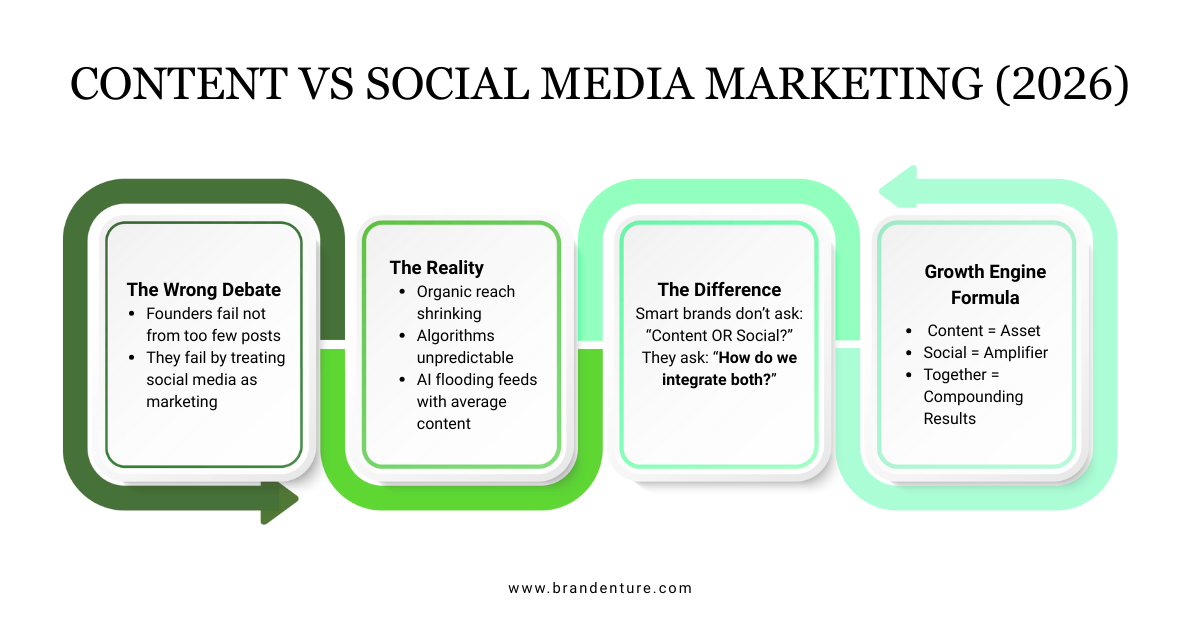
Founders, solopreneurs, and small business owners aren’t failing because they don’t post enough. They’re failing because they treat social media as marketing instead of understanding how social media and content marketing work together as a system.
Organic reach is shrinking. Algorithms are unpredictable. AI has flooded platforms with average content. Yet, some startups continue to grow consistently,
generate inbound leads, and build authority,without chasing trends or posting 3 times a day.
The difference?
They don’t ask “Should we focus on content marketing or social media marketing?”
They ask “How do we integrate both to build a growth engine we actually control?”
This guide answers that question.
By the end of this article, you’ll understand:
- The real difference between content marketing vs social media
- Why social media alone is no longer a growth strategy
- How to build a content marketing social network that compounds results
- A practical integration framework designed for solopreneurs, SMBs, and startups
- How winning brands use content as the asset and social media as the amplifier
1. Why This Debate Still Matters in 2026
If you’re a small business owner or startup founder, you’ve probably experienced at least one of these:
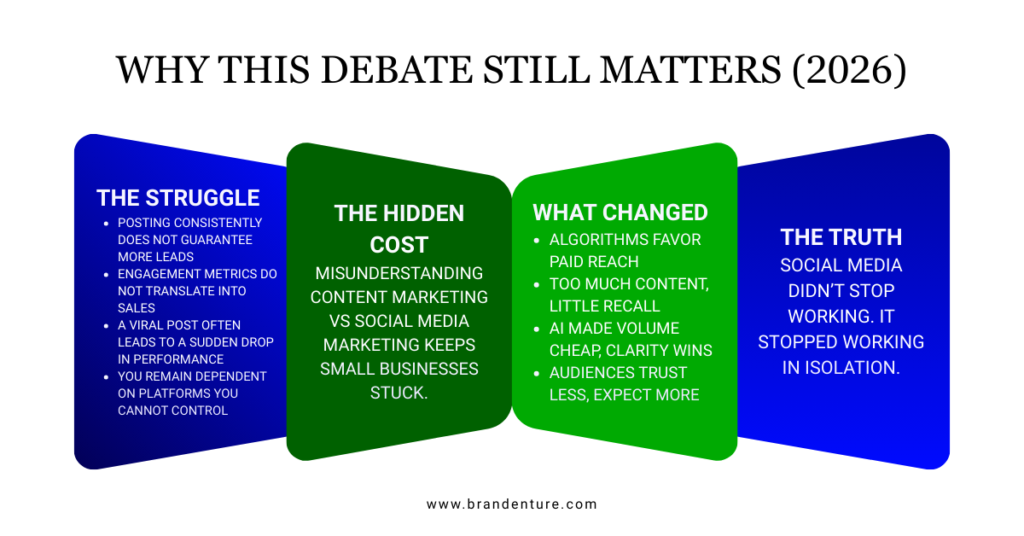
- You post consistently, but leads don’t increase
- Engagement looks “okay,” but sales stay flat
- A post performs well, then everything drops again
- You feel dependent on platforms you don’t control
This is the hidden cost of misunderstanding the difference between content marketing and social media marketing.
What Changed in 2026?
Several shifts have reshaped digital marketing:
- Algorithm volatility: Platforms now prioritize paid reach, retention, and native formats
- Content saturation: Everyone is posting, fewer people are remembering
- AI commoditization: Volume is no longer a differentiator,clarity is
- Trust deficit: Audiences are more skeptical, not more impressed
Social media didn’t stop working. It stopped working in isolation.
2. Defining the Foundations
Before integration, clarity is required.
2.1 What Is Content Marketing in 2026?
Content marketing is the strategic creation and distribution of owned content assets designed to attract, educate, and convert a clearly defined audience over time.
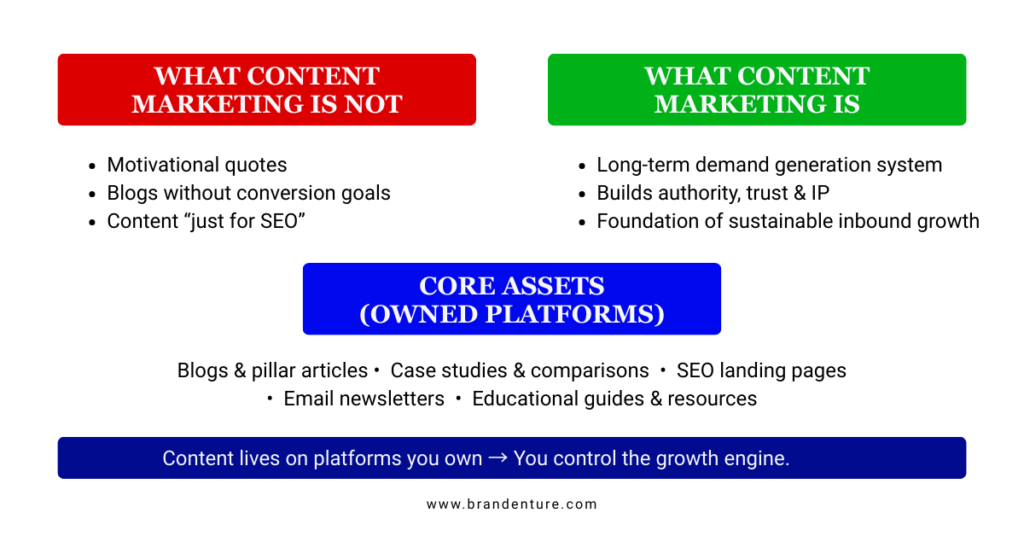
In 2026, content marketing is not:
- Posting motivational quotes
- Writing blogs without a conversion goal
- Creating content “for SEO only”
It is:
- A long-term demand generation system
- A way to build authority, trust, and intellectual property
- The foundation of sustainable inbound growth
Core content marketing assets include:
- Blogs and pillar articles
- Case studies and comparisons
- SEO landing pages
- Email newsletters
- Educational resources and guides
These assets live on platforms you own.
2.2 What Is Social Media Marketing in 2026?
Social media marketing is the distribution, engagement, and amplification layer of your brand’s communication.
Social platforms are not libraries.
They are attention streams.
In 2026, social media excels at:
- Discovery
- Awareness
- Community interaction
- Top-of-funnel education
But it comes with a hard truth:
You don’t own your reach. You rent it.
When the algorithm changes, visibility changes.
When trends shift, formats die.
2.3 Social Media and Content Marketing: Where Most Businesses Get Confused
The biggest mistake SMBs and startups make is treating social media as content marketing.
Posting ≠ strategy
Engagement ≠ growth
Consistency ≠ compounding value
This confusion leads to:
- Burnout without ROI
- Random posting without direction
- No clear conversion path
3. Content Marketing vs Social Media Marketing: Core Strategic Differences
Let’s break this down clearly.
Comparison Table: Content Marketing vs Social Media Marketing
| Dimension | Content Marketing | Social Media Marketing |
| Ownership | Owned platforms | Third-party platforms |
| Lifespan | Evergreen | Short-lived |
| Primary Goal | Authority & trust | Awareness & engagement |
| Traffic Type | Intent-driven | Discovery-driven |
| ROI Curve | Compounding | Spiky |
| Control | High | Low |
| Best Use | Demand creation | Demand amplification |
3.1 Ownership vs Access
- Content marketing builds assets you control
- Social media gives access to audiences you don’t
This is why startups that rely only on social media struggle to scale.
3.2 Longevity vs Velocity
A well-written blog can generate leads for years.
A social post lives for hours,or days at best.
Social media gives speed.
Content marketing gives depth.
3.3 Authority vs Attention
Attention is rented.
Authority is earned.
Content positions your brand as a problem-solver, not just a presence.
4. The Role of the Content Marketing Social Network
A content marketing social network is not a platform, it’s a system.
What It Looks Like in Practice
Your ecosystem might look like this:
Blog / Website (Content Hub)
↓
Email Newsletter (Relationship Layer)
↓
LinkedIn / Instagram / Facebook (Distribution Nodes)
↓
Community / Leads / Sales
Social media is not the destination.
It’s the highway.
Why Startups Need a Central Content Hub
Without a hub:
- Social traffic dies with the post
- Learnings aren’t captured
- Authority is fragmented
With a hub:
- Social content feeds owned assets
- SEO compounds
- Brand positioning stays consistent
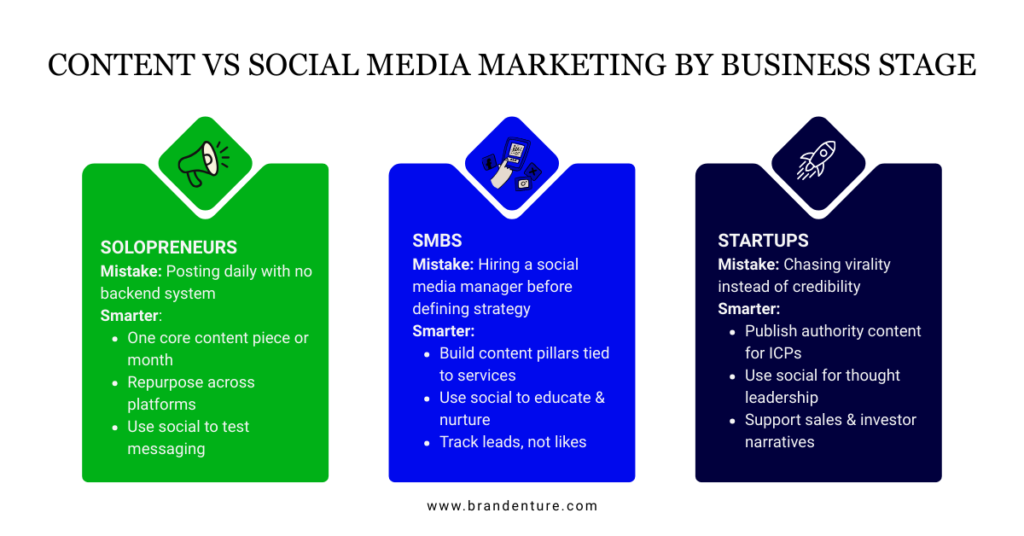
5. Content Marketing vs Social Media Marketing for Different Business Stages
5.1 Solopreneurs
Common mistake: Posting daily with no backend system.
Smarter approach:
- One core content piece per month
- Repurpose across platforms
- Use social media to test messaging
5.2 Small & Medium Businesses (SMBs)
Common mistake: Hiring a social media manager before defining strategy.
Smarter approach:
- Build content pillars aligned with services
- Use social media to educate and nurture
- Track leads, not likes
5.3 Startups
Common mistake: Chasing virality instead of credibility.
Smarter approach:
- Publish authority content for ICPs
- Use social media for thought leadership
- Support sales and investor narratives
6. How Social Media Strengthens Content Marketing (When Used Correctly)
Social media becomes powerful when it serves content,not replaces it.
Strategic Roles of Social Media
- Distribution: Push content to the right audience
- Validation: See what resonates before scaling
- Feedback: Identify objections and FAQs
- Community: Humanize the brand
Repurposing Framework Example
One blog post can become:
- LinkedIn carousel (key insights)
- Instagram Reel (one core idea)
- Twitter/X thread (summary points)
- Email newsletter (context + CTA)
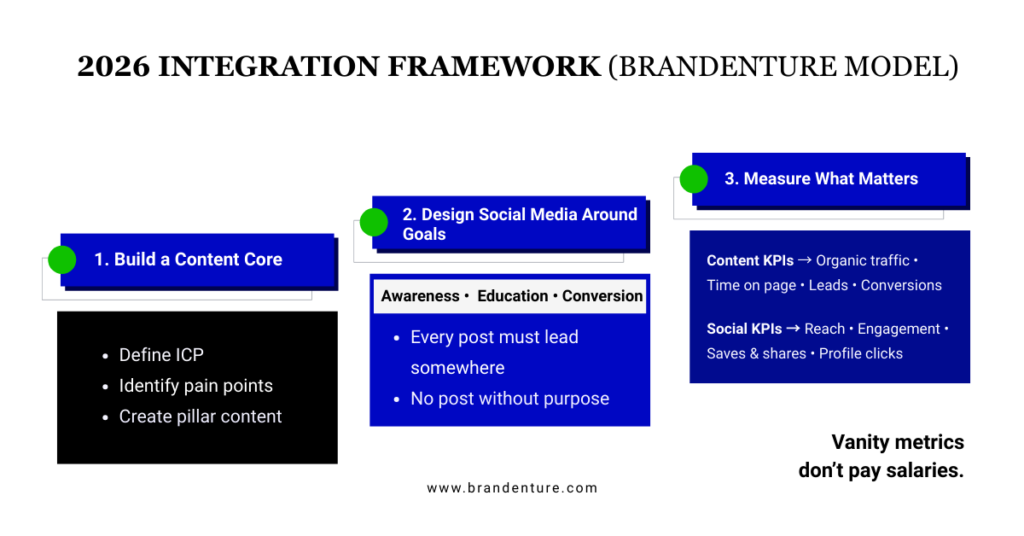
7. The 2026 Integration Framework (Brandenture Model)
This is where content marketing vs social media marketing becomes a system.
Step 1: Build a Content Core
- Define your ICP
- Identify key pain points
- Create pillar content around them
Step 2: Design Social Media Around Business Goals
Ask:
- Is this post for awareness, education, or conversion?
- Where does it lead?
No post should exist without a purpose.
Step 3: Measure What Actually Matters
| Content KPIs | Social Media KPIs |
| Organic traffic | Reach |
| Time on page | Engagement |
| Leads | Saves & shares |
| Conversions | Profile clicks |
Vanity metrics don’t pay salaries.
8. Local E-commerce SMB: From Instagram Growth to Actual Sales (A Case Study)
The Problem: Strong Instagram Growth but Zero Orders
This local e-commerce SMB had what many startups think is success: consistent Instagram follower growth, decent engagement, and visually appealing posts. However, none of that attention was translating into sales.
The core issues were:
- Instagram was acting as the final destination, not a traffic channel
- No clear product education beyond captions
- No structured website content to answer buyer questions
- Users were engaging with posts but had no reason or path to purchase
In short, visibility existed, but conversion infrastructure didn’t.
The Solution: Content-Led Conversion Strategy
Instead of posting more frequently, the strategy focused on supporting social media with conversion-focused content.
1. Built High-Intent Service Pages & FAQs
Dedicated service and product pages were created to address:
- Product benefits vs. alternatives
- Pricing clarity
- Shipping, returns, and trust signals
- Common objections answered through FAQs
This ensured that when users clicked from Instagram, they landed on pages designed to convert curiosity into confidence.
2. Used Social Media as a Traffic Driver (Not a Sales Tool)
Instagram content was repositioned to:
- Educate instead of push sales
- Tease solutions and redirect users to the website
- Use Stories, bio links, and CTAs to guide users to specific pages
Each post had a single purpose: move users one step closer to purchase.
The Result: Fewer Posts, Higher Conversions
Within weeks of implementing the strategy:
- Posting frequency was reduced by nearly 40%
- Website sessions increased due to clearer CTAs
- Conversion rate improved as users landed on relevant pages
- Instagram engagement stayed stable—but orders finally started coming in
Key takeaway:
Social media created demand, but content marketing closed the sale.
This example shows that growth metrics are meaningless unless your content ecosystem is designed to convert attention into revenue.
9. Common Mistakes in Content Marketing vs Social Media Marketing
Here are nine mistakes SMBs do in both content and social media marketing:
- Posting without a conversion path
- Treating trends as strategy
- Ignoring owned platforms
- Measuring success by engagement alone
10. Content Marketing vs Social Media Marketing: The Final Verdict
The real answer isn’t which one is better.
The real answer is:
Content marketing builds the asset.
Social media distributes the asset.
If you’re a:
- Solopreneur: Start with content clarity, then social
- SMB: Build systems, not posting schedules
- Startup: Invest in authority before scale
11. Conclusion: From Posting to Positioning
In 2026, growth doesn’t come from doing more.
It comes from doing the right things in the right order.
Content creates trust.
Social media creates visibility.
Strategy connects them.
If you want marketing that compounds instead of exhausts, stop choosing between content marketing vs social media marketing,and start integrating them
Talk to Our Expert
Your message has been sent
FAQs
The main difference between content marketing and social media marketing is ownership and purpose. Content marketing focuses on creating owned assets such as blogs, guides, and emails that build long-term authority and generate demand over time. Social media marketing focuses on distributing and amplifying content on third-party platforms to increase visibility, engagement, and reach.
Content marketing is generally more effective for small businesses in the long term because it builds assets that continue to generate traffic and leads. Social media marketing works best when used alongside content marketing to distribute content and attract attention, but relying on social media alone can limit control and scalability.
Social media marketing can work without content marketing, but results are usually short-lived. Without strong content assets behind social posts, businesses often struggle to convert engagement into leads or sales. Content marketing provides the depth and credibility that social media alone cannot sustain.
Content marketing and social media marketing work together by serving different roles in the same system. Content marketing creates valuable, educational assets that build trust and authority, while social media marketing distributes those assets, drives traffic, and sparks conversations with the target audience.
A content marketing social network is a strategic ecosystem where content lives on owned platforms such as a website or email list, while social media platforms act as distribution channels. This approach reduces dependency on algorithms and helps businesses build a consistent, scalable marketing system.
Content marketing typically delivers better long-term ROI because its impact compounds over time through search traffic, backlinks, and authority. Social media marketing often delivers faster but less predictable results. The highest ROI comes from integrating both strategies rather than choosing one over the other.
Startups should prioritize content marketing to establish authority and credibility, especially in competitive markets. Social media marketing should then be used to amplify that content, support brand visibility, and validate messaging. This balance helps startups grow without relying entirely on paid or algorithm-driven reach.