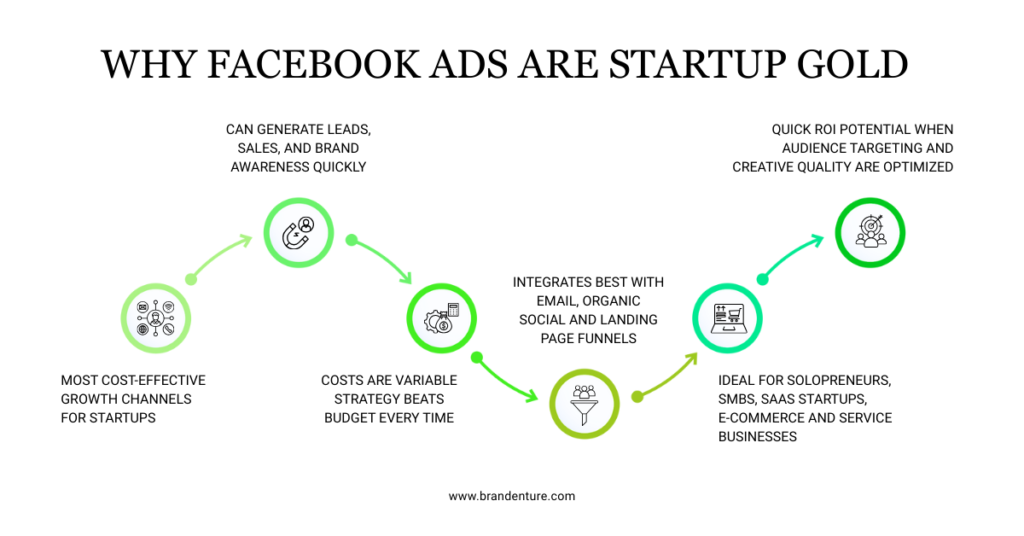
Facebook (Meta) advertising remains one of the most powerful growth channels for startups, but it’s also one of the most misunderstood. Some founders hear stories of $2 leads and overnight success. Others burn money and conclude that Facebook ads “don’t work.”
The truth lies in understanding how Facebook advertising costs actually work, what startups should realistically expect to pay, and how Facebook ads should integrate into a broader marketing strategy, not operate in isolation.
This guide is written for solopreneurs, SMBs, and startups who want clarity, not hype. By the end, you’ll know:
- What Facebook ads really cost
- How to budget intelligently
- When Facebook ads make sense, and when they don’t
- How to reduce costs while increasing results
How Facebook Advertising Pricing Works
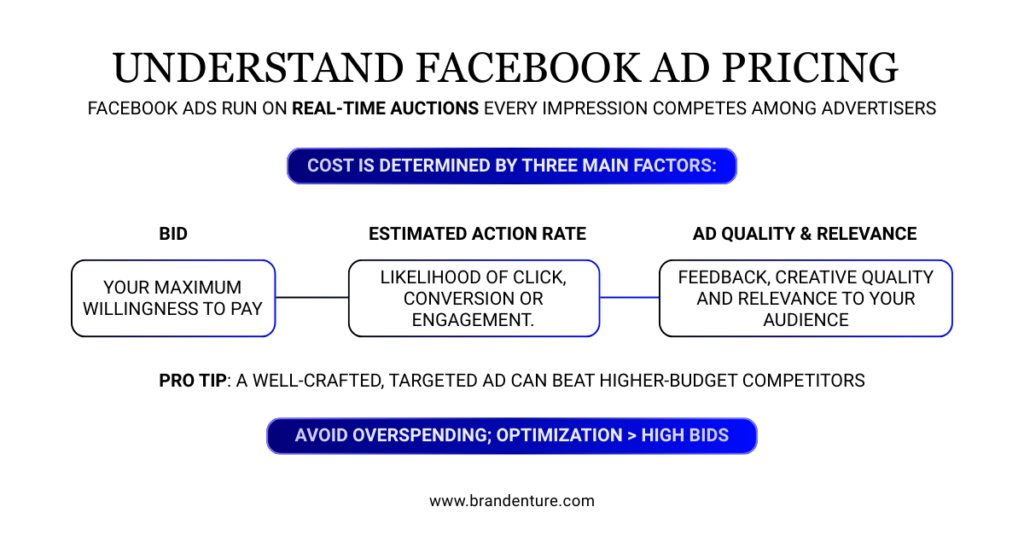
Facebook does not have fixed advertising prices. Instead, it uses a real-time auction system that determines which ads get shown, to whom, and at what cost.
Understanding this system is essential for startups, because cost efficiency comes from strategy, not spending more money.
Facebook Ads Auction System Explained
Every time a user opens Facebook or Instagram, Meta runs an instant auction among advertisers targeting that user. The winner is not simply the highest bidder.
Facebook considers three core factors:
- Bid – How much you’re willing to pay
- Estimated Action Rate – Likelihood of the user clicking, converting, or engaging
- Ad Quality & Relevance – User feedback, creative quality, and engagement
This means:
- A well-targeted, high-quality ad can beat a higher-budget competitor
- Poor creatives increase costs even if budgets are high
For startups, this levels the playing field, strategy can outperform spend.
Cost Models Used in Facebook Advertising
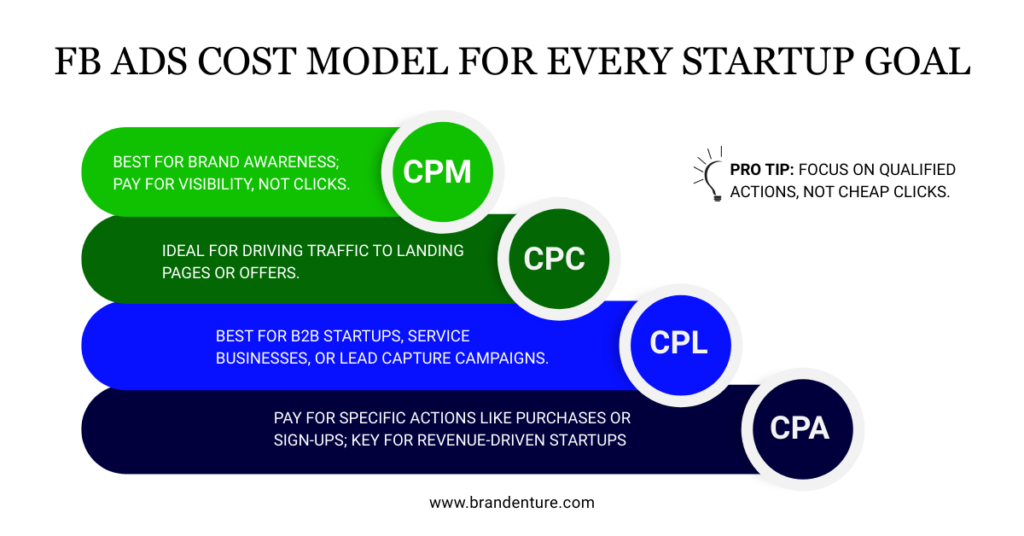
Facebook offers multiple pricing models depending on your campaign objective:
CPM (Cost Per 1,000 Impressions)
You pay for visibility. Best for brand awareness.
CPC (Cost Per Click)
You pay when someone clicks your ad. Common for traffic campaigns.
CPL (Cost Per Lead)
You pay when someone submits a form. Ideal for service businesses and B2B startups.
CPA (Cost Per Acquisition)
You pay for a specific conversion (purchase, signup). Most relevant for revenue-driven startups.
Startups should focus less on cheap clicks and more on cost per qualified outcome.
Average Facebook Advertising Costs for Startups
While costs vary by industry, region, and competition, there are reliable benchmarks that startups can use for planning.
Average Facebook Ad Costs (Benchmarks)
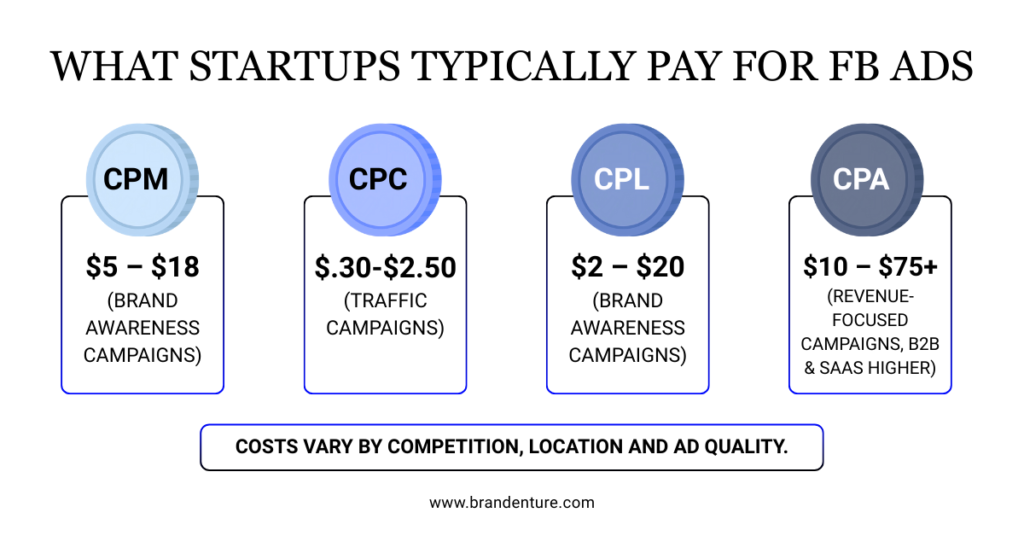
Global averages typically fall within these ranges:
- CPM: $5 – $18
- CPC: $0.30 – $2.50
- Cost per Lead: $2 – $20
- Cost per Purchase: $10 – $75+
High-ticket B2B or SaaS startups often see higher CPAs, while local service businesses may achieve lower CPLs.
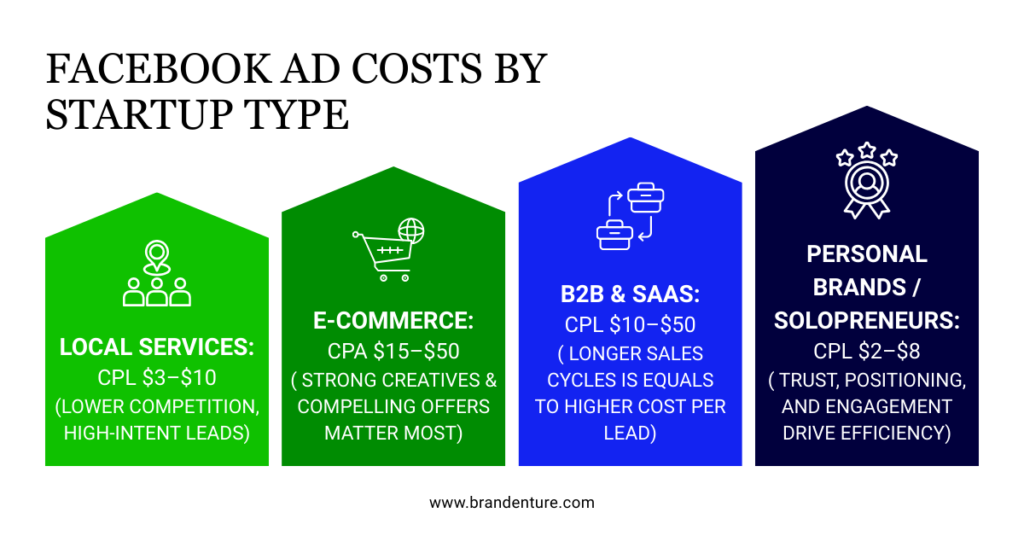
Facebook Ad Costs by Business Type
Local Service Startups
- CPL: $3–$10
- Lower competition, high intent
E-commerce Startups
- CPA: $15–$50
- Strong creatives and offers matter most
B2B & SaaS Startups
- CPL: $10–$50
- Longer sales cycles increase perceived costs
Personal Brands & Solopreneurs
- CPL: $2–$8
- Trust and positioning drive efficiency
Facebook Ad Costs by Campaign Objective
- Brand Awareness: Lowest CPM, minimal immediate ROI
- Traffic Campaigns: Cheap clicks, inconsistent conversions
- Lead Generation: Most startup-friendly
- Sales Campaigns: Higher cost, higher payoff when funnels work
How Much Should Startups Budget for Facebook Ads?
There is no universal “right” budget, but there is a wrong approach: spending without structure.
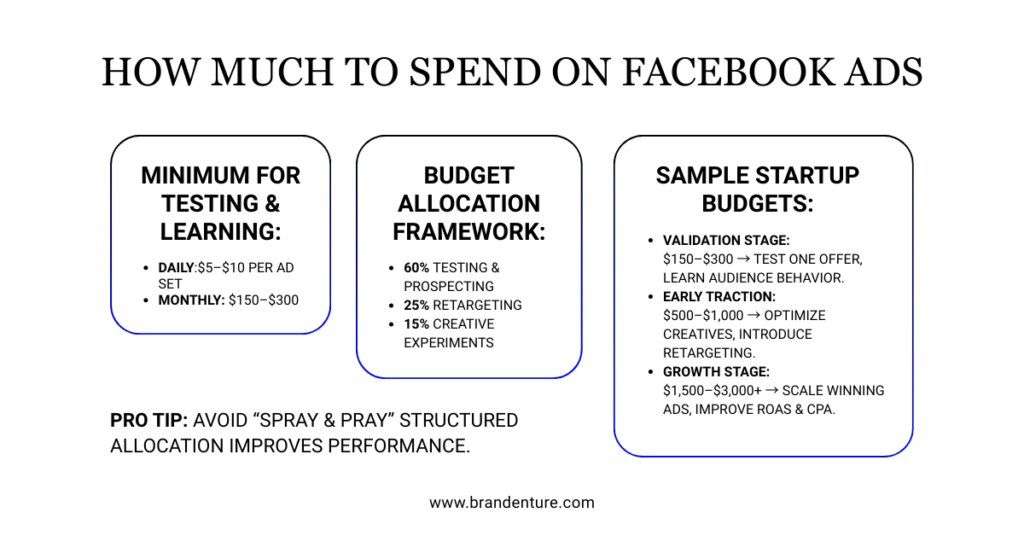
Minimum Facebook Ad Budget for Startups
Facebook’s algorithm needs data. Extremely low budgets slow learning.
Recommended minimums:
- Daily: $5–$10 per ad set
- Monthly: $150–$300 for testing
Anything below this limits optimization.
Sample Facebook Ad Budgets for Startups
Validation Stage ($150–$300/month)
- Test one offer
- Learn audience behavior
Early Traction ($500–$1,000/month)
- Optimize creatives
- Introduce retargeting
Growth Stage ($1,500–$3,000+/month)
- Scale winning ads
- Improve ROAS and CPA
Budget Allocation Framework
- 60% testing & prospecting
- 25% retargeting
- 15% creative experiments
This prevents budget waste and supports long-term scalability.
What Drives Facebook Advertising Costs?
Facebook ad costs rise when startups ignore fundamentals.
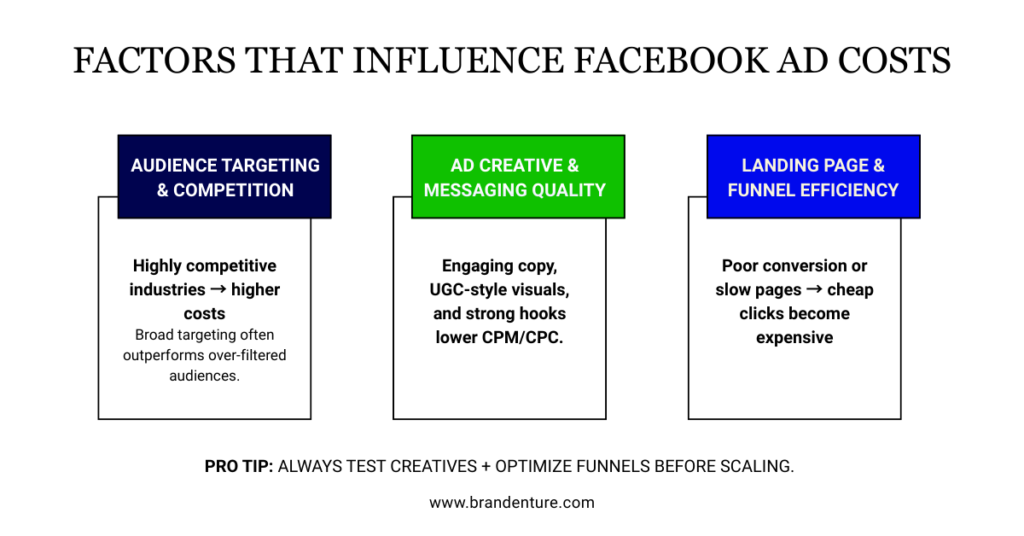
Audience Targeting & Competition
Highly competitive industries (finance, real estate, SaaS) drive costs up. Broad targeting often performs better than over-filtered audiences.
Ad Creative & Messaging Quality
Facebook rewards ads people enjoy. Poor hooks, generic copy, and stock images increase CPM and CPC.
Short-form video, UGC-style ads, and clear value propositions lower costs.
Landing Page & Funnel Efficiency
Even cheap clicks become expensive if landing pages don’t convert. Page speed, clarity, trust signals, and alignment with ad copy are critical.
Facebook Advertising Costs vs ROI for Startups
Cost alone is meaningless without context.
A $20 lead is expensive only if:
- Your product is $30
- You don’t follow up
It’s cheap if:
- Your LTV is $500
- Your sales process converts well
Cost vs Business Metrics
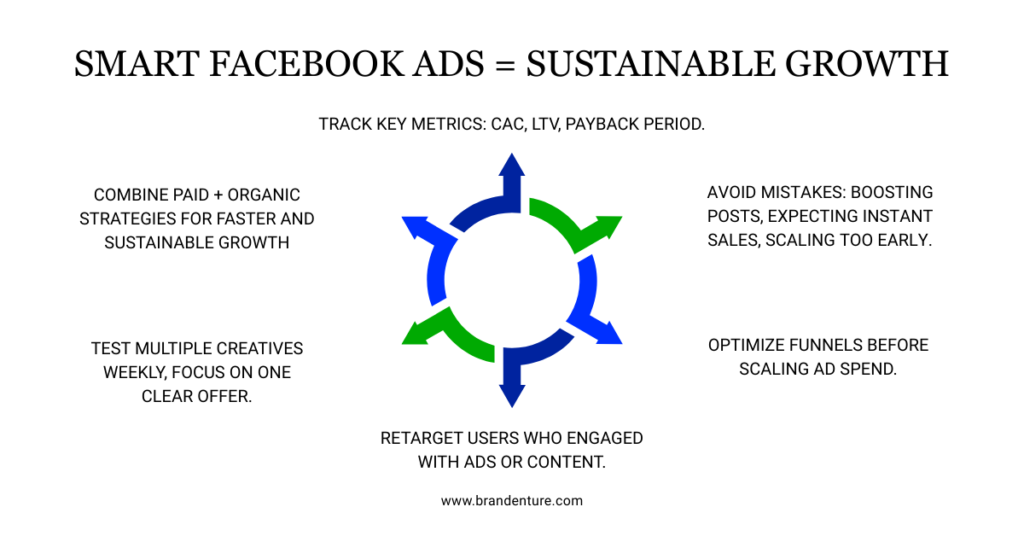
Startups should track:
- CAC (Customer Acquisition Cost)
- LTV (Lifetime Value)
- Payback period
Facebook ads are a growth accelerator, not a magic fix.
Facebook Ads vs Other Marketing Channels
FB Ads vs Google Ads
- Facebook = demand creation
- Google = demand capture
FB Ads vs Organic Social
- Paid = speed
- Organic = sustainability
The smartest startups combine both.
How Startups Can Reduce Facebook Advertising Costs
- Test multiple creatives weekly
- Focus on one clear offer
- Retarget engaged users
- Optimize funnels before scaling
Lower costs come from system thinking, not hacks.
Common Facebook Advertising Cost Mistakes
- Boosting posts instead of running structured campaigns
- No funnel or follow-up
- Expecting sales without trust
- Scaling too early
Real Facebook Advertising Cost Scenarios
Local Service Startup
- $300/month → 30 leads → 5 clients
SaaS Startup
- $1,000/month → 80 leads → 8 demos → 2 customers
E-commerce Startup
- $2,000/month → ROAS 2.8x after optimization
Is Facebook Advertising Worth It for Startups?
Yes, if:
- You have a clear offer
- You understand your audience
- You integrate ads into a broader marketing strategy
No, if you expect ads to fix poor positioning.
Final Thought
Facebook advertising is not about spending more, it’s about spending smarter. For startups, Facebook ads should support brand building, lead generation, and growth, not replace strategy.
FAQs
As little as $5/day, but $10–$20/day performs better.
Only if strategy is missing.
Typically 7–14 days for meaningful data.